

If you’ve ever tried correcting paint around badges, tight curves, mirror caps, bumpers, spoilers, or modern body lines, you already know the truth: a full-size polisher can be the wrong tool for the job. That’s exactly where a mini polisher for detailing earns its keep.
In this 2026 guide, I’m sharing the five mini polishers I recommend for professional-level work—with clear use cases, pros/cons, and direct links to buy from Auto Premium Supply.
Why a Mini Polisher Changes Everything in Pro Detailing

A mini polisher gives you control in places where a 5–6" machine simply can’t stay flat or safe. On tight panels and sharp contours, a compact tool helps you:
- Correct defects safely without riding edges or burning through paint
- Maintain pad contact on curves and recessed areas
- Finish cleaner on sensitive paint where large pads can haze
- Work faster because you’re not fighting the tool’s footprint
Mini DA vs Nano (Micro) vs Small Detail Polisher: Which Type Do You Need?
"Mini polisher" is used for three different kinds of tools. Picking the right type matters more than picking the brand:
| Type | Typical pad / plate | Movement | Use it for | Examples at APS |
|---|---|---|---|---|
| Mini DA polisher | 75 mm (3") backing plate | Random orbital, 12 mm orbit | Bumpers, pillars, mirrors, spoilers, spot correction | RUPES HLR75 Mini iBrid, RUPES LHR75E Mini |
| Nano / micro polisher | 30 mm (1¼") and 50 mm (2") plates | Interchangeable heads: 3 mm orbit, 12 mm orbit or rotary | Emblems, A-pillars, piano-black trim, door cups, intricate areas | RUPES iBrid Nano (short/long neck), RUPES iBrid Nano 2, Maxshine M0312 V2 |
| Small detail polisher (rotary attachment) | Mini backing plates and small pads | Rotary, driven by a rotary polisher you already own | Intricate rims, shifters, emblems, door-handle cups | Maxshine Mini Polishing System MN01 (polisher not included) |
Rule of thumb: if the area still fits a 3" pad, a mini DA gives you correction with a familiar random-orbital feel. If it doesn't, you need a nano/micro tool with 30–50 mm pads.
How I Picked the Top 5 Mini Polishers for 2026
To keep this list genuinely useful, I focused on mini polishers that excel in the real world—tight areas, complex panels, and precision finishing. The winners stand out for:
- Size + maneuverability (especially around edges and contours)
- Correction ability relative to their footprint
- Control (stable speed delivery + user-friendly ergonomics)
- System support (pads, backing plates, accessories, and polish compatibility)
Quick Comparison: Top 5 Mini Polishers (2026)
| Mini Polisher | Best For | Why It’s Great | Link |
|---|---|---|---|
| RUPES iBrid Nano Short Neck (HR81M/LUX) | Ultra-tight areas, micro finishing, precision work | 3-in-1 movement platform for micro-correction and control | View product |
| RUPES iBrid Nano Long Neck (HR81ML/LUX) | Recesses, contours, and harder-to-reach geometry | Longer reach with the same versatile movement system | View product |
| RUPES HLR75 Mini iBrid (3" DA) | Curves, bumpers, pillars, tight panels—true mini DA correction | iBrid flexibility (cordless + corded) with a 3" DA footprint | View product |
| RUPES BigFoot LHR75E Mini | Spot repair, small panels, consistent corded polishing | Compact 75mm platform with strong, steady power delivery | View product |
| Maxshine Mini Polishing System (MN01) | Micro polishing with a rotary setup (tool not included) | A practical mini kit for ultra-small pads and detail work | View product |
Manufacturer specs side by side
Specs as published by each manufacturer (sources below the table). Prices and stock change, so check the product page.
| Model | Type | Orbit / movement | Backing plate | Power | Speed | Weight |
|---|---|---|---|---|---|---|
| RUPES HLR75 Mini iBrid | Mini DA, cordless + corded | 12 mm random orbital | 75 mm (3") | 18 V battery (approx. 35–45 min per charge) or iBrid power adapter | 3,000–5,500 rpm | 1.1 kg (without battery) |
| RUPES BigFoot LHR75E Mini | Mini DA, corded | 12 mm random orbital | 75 mm (3") | 400 W | 4,000–5,500 rpm | 2.3 kg |
| RUPES iBrid Nano Short Neck (HR81M) | Nano / micro, cordless + corded | 3 mm orbital, 12 mm orbital or rotary (interchangeable) | 30 mm (1¼") / 50 mm (2") | 10.8–12 V DC (approx. 30 min per charge) | 2,000–5,000 rpm | 470 g* |
| RUPES iBrid Nano Long Neck (HR81ML) | Nano / micro, extra reach | 3 mm, 12 mm or rotary | 30 mm / 50 mm | 10.8–12 V DC | 2,000–5,000 rpm | 520 g* |
| RUPES iBrid Nano 2 (HR81MLII) | Nano / micro, 2nd generation | 3 mm, 12 mm or rotary (rotary up to 2,000 rpm with 50 mm plates); SMARTFIX quick-release heads | 30 mm / 50 mm | 10.8–12 V DC (approx. 30 min per charge) | 2,000–5,000 rpm | 500 g* |
| Maxshine Mini Cordless Polisher V2 (M0312 V2) | Hybrid rotary + DA, cordless | Rotary, or DA with 3 mm / 12 mm orbit | 1.5" and 2" plates included | 12 V, 80 W; two 2.0 Ah batteries | 2,000–4,700 rpm (6 settings) | — |
| Maxshine Mini Polishing System (MN01) | Rotary attachment kit | Rotary, driven by your machine through a flexible shaft (M14 or 5/8" adapter) | Ø1.5 cm and Ø2.5 cm mini plates and pads | — (polisher not included) | — | — |
*RUPES Nano weights are measured without functional unit, battery pack or power supply. Sources: rupes.com product pages for HLR75, LHR75E, iBrid Nano (short/long neck) and iBrid Nano 2; maxshine.cn (Maxshine official) for M0312 V2 and MN01.
Shop the 2026 Mini Polisher Picks
These are the mini polishers featured in this guide. Click any card to view details and buy directly from Auto Premium Supply.
Need pads and liquids to match your mini setup? Grab them here: Polishing Pads · Compounds & Polishes · Mini Polishers

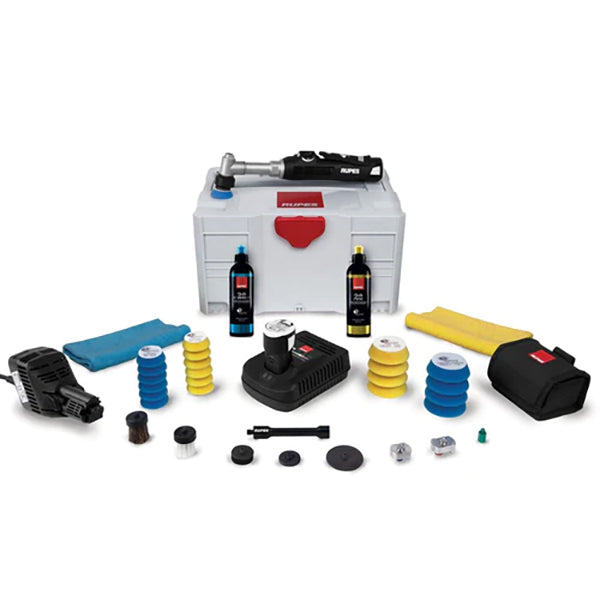


1) RUPES iBrid Nano Short Neck (HR81M/LUX)

If your work lives in the “hardest 10%” of a vehicle—tight gaps, intricate trim areas, and micro finishing—this is the type of tool that feels like cheating (in the best way). The short neck format keeps things extremely controlled when you’re polishing in spaces where even a 3" DA can feel big.
Best use cases
- Badges, emblems, A-pillars, piano black trims
- Ultra-tight zones where you need maximum control
- Micro polishing and refinement work
Pros
- Compact and precise for tight-area detailing
- Versatile platform designed for micro-level work
Cons
- Not meant to replace a full-size DA for large panels
2) RUPES iBrid Nano Long Neck (HR81ML/LUX)

Same idea as the Nano short neck—just with extra reach. If you work a lot around complex modern body lines, recessed shapes, or areas where your hand position gets awkward, the long neck format is a very practical upgrade.
Best use cases
- Recessed contours and hard-to-reach geometry
- Precision polishing where reach matters
Pros
- Longer reach helps keep the tool stable in awkward areas
- Versatile system approach for micro work
Cons
- Like all micro tools, it shines on detail work—not big panels
3) RUPES HLR75 Mini iBrid (3" DA)

This is the one I’d call a “true mini DA” for real correction on tight panels. The footprint is compact, but it’s built for curves, bumpers, pillars, mirrors, spoilers—places where you still need meaningful correction without risking edges.
Best use cases
- Bumpers, pillars, tight curves, mirrors, spoilers
- Motorcycles, headlights, spot correction
- A perfect companion to a full-size DA
Pros
- Mini DA footprint for controlled correction
- iBrid flexibility for mobility vs. continuous sessions
Cons
- For large panels, a 5–6" DA will always be faster
4) RUPES BigFoot LHR75E Mini

If you want a compact 75mm platform but prefer the simplicity and consistency of a corded tool, the LHR75E Mini is a classic. It’s built for intricate shapes and spot repair style polishing—reliable, steady, and predictable.
Best use cases
- Spot repair polishing and small panel correction
- Intricate shapes where a larger tool won’t stay flat
Pros
- Consistent power delivery (corded)
- Compact platform for tight polishing
Cons
- Cord management is part of the deal
5) Maxshine Mini Polishing System (MN01)

This one is different: it’s a mini polishing system kit intended for extremely small pads and detailed work using compatible rotary machines (the rotary tool itself is not included). If you already run rotary setups and want to go micro, this is a practical kit to have.
Best use cases
- Ultra-small pads and micro polishing tasks
- Users who already have compatible rotary machines
Pros
- Useful kit for detailed, tiny polishing points
- Good add-on for a shop that already runs rotary
Cons
- Rotary polisher not included
Best Mini DA Polisher (3"): HLR75 Mini iBrid vs LHR75E Mini
Both RUPES minis share the same footprint for real correction on tight panels: a 75 mm (3") backing plate and a 12 mm orbit. The difference is how they're powered:
- RUPES HLR75 Mini iBrid: 18 V battery (RUPES quotes approx. 35–45 minutes of continuous use per charge) or corded through the iBrid power adapter; 3,000–5,500 rpm; 1.1 kg without battery. Pick it if you move around the car a lot or work mobile.
- RUPES BigFoot LHR75E Mini: corded, 400 W, 4,000–5,500 rpm, 2.3 kg. RUPES describes it as the polisher for difficult shapes and spot repair. Pick it if you polish at a fixed station and want no battery management.
If you already own a 5" or 6" DA, either one is the natural second machine. Still choosing that main machine? See our guide to full-size DA polishers and our RUPES LHR15 vs LHR21 Mark V comparison.
Best Micro / Nano Polisher: RUPES iBrid Nano, Nano 2 or Maxshine M0312 V2
A nano (micro) polisher is a different class of tool: 30–50 mm pads and interchangeable heads (3 mm orbit for finishing, 12 mm orbit for correction, rotary for maximum bite in tiny areas).
- RUPES iBrid Nano, short neck (HR81M): the most compact option for emblems, piano-black trim and A-pillars. 10.8–12 V, 2,000–5,000 rpm, approx. 30 minutes per battery, and corded through the included AC-DC adapter. Available at APS as a Box Kit or a Starter Kit.
- RUPES iBrid Nano, long neck (HR81ML): same specs with extra reach for recesses (520 g vs 470 g). Box Kit · Starter Kit.
- RUPES iBrid Nano 2 (HR81MLII): the second generation. RUPES adds a SMARTFIX quick-release system for the heads and a gear-reduction rotary mode (up to 2,000 rpm with 50 mm plates) for more torque.
- Maxshine Mini Cordless Polisher V2 (M0312 V2): a hybrid body that works as a rotary or as a dual action with 3 mm or 12 mm orbit. Maxshine lists 12 V, 80 W, 2,000–4,700 rpm in six settings, two 2.0 Ah batteries and 1.5" and 2" backing plates. It's the lower-cost way into nano-size polishing.
Best Small Detail Polisher for Emblems, Rims and Door Cups
For the smallest jobs (intricate rims, shifters, emblems, door-handle cups) you can use the rotary head of a nano tool, or add the Maxshine Mini Polishing System (MN01) to a rotary you already own. According to Maxshine it is driven by a rotary polisher through a flexible shaft (M14 or 5/8" adapter) and includes Ø1.5 cm and Ø2.5 cm mini plates and red, green, felt, wool and orange mini pads. The rotary polisher is not included.
Which One Should You Buy?
- For the tightest, most intricate work: iBrid Nano Short Neck
- For recesses + extra reach: iBrid Nano Long Neck
- For mini DA correction on curves: HLR75 Mini iBrid
- For a simple, steady corded mini platform: LHR75E Mini
- For micro pads with rotary compatibility: Maxshine MN01 kit
- For a second-generation nano with quick-change heads: RUPES iBrid Nano 2
- For nano-size polishing on a tighter budget: Maxshine Mini Cordless Polisher V2
Pro Mini-Polishing Tips (Fast, Clean Results)
- Work small: mini polishers reward small sections and controlled passes.
- Keep pads fresh: clean or swap pads often—tiny pads load up quickly.
- Use good lighting: small areas hide defects until you inspect correctly.
- Don’t overdo pressure: let the tool work; forcing it usually worsens finish quality.
New to machine polishing? Read car polishing for beginners: common mistakes and how to avoid them.
Get the Full Setup from Auto Premium Supply
If you want the cleanest results, match your mini polisher with the right consumables:
FAQ: Mini Polishers for Detailing
Is a mini polisher worth it if I already own a 5" DA?
Yes—because it’s not about replacing your main polisher. It’s about doing the tight-area work faster, safer, and cleaner than trying to force a large pad into a bad angle.
Do I need a mini DA or a micro tool (Nano-style)?
If you mainly polish curves and tight panels, a mini DA (HLR75 / LHR75E) is usually the move. If you do a lot of micro polishing and intricate detailing, a Nano-style system shines.
What pads should I run on a mini polisher?
It depends on your goal: cutting, polishing, or finishing. Start with the least aggressive option that achieves the result, and step up only if needed.
What size pad does a mini polisher use?
Mini DA polishers like the RUPES HLR75 and LHR75E run a 75 mm (3") backing plate. Nano/micro tools such as the RUPES iBrid Nano use 30 mm (1¼") and 50 mm (2") plates. Always match pad size to the plate your machine is designed for.
Cordless or corded mini polisher?
Cordless gives you freedom around the car: RUPES quotes approx. 35–45 minutes per charge for the HLR75 and approx. 30 minutes for the iBrid Nano, and both iBrid tools can also run corded with their adapter. A corded tool like the LHR75E (400 W) never stops for charging. Many pros keep one of each.
Is a nano polisher the same as a mini DA?
No. A mini DA is a scaled-down random orbital (3" plate, 12 mm orbit). A nano/micro polisher uses much smaller pads and lets you switch between 3 mm orbit, 12 mm orbit and rotary heads, so it reaches spots a 3" pad can't.
Can I use a mini polisher as my only polisher?
You can, but it's slow on hoods, roofs and doors. A mini or nano is built for the tight 10–20% of the car; pair it with a 5"–6" DA for large panels (see our polisher comparison: rotary vs dual action vs gear-driven).


