
Short answer: for most people, the best car polisher is a dual action (DA) / random orbital polisher. It removes swirls and light defects with far less risk than a rotary and is the easiest to learn. Rotary and gear-driven (forced rotation) machines have their place, but for users with technique or heavy correction work. Below: how to choose by type, by user and by brand.
Here’s the idea that matters most (and I’m going to say it exactly as it should be understood): you’re not just buying a machine—you’re buying a result. Result = fewer swirls and micro-marring, faster correction, higher gloss, and a safer process for your clear coat.
Quick navigation
Quick decision (20 seconds)
- Most people should buy a Dual Action (DA) / random orbital polisher. It’s the best mix of safety + results.
- If you want one machine for almost everything, I’d start with a 15 mm throw (control + balance).
- If you’re doing large panels all day (SUVs, vans, big hoods), 21 mm can save real time.
- If you want a truly complete finish, add a mini (pillars, bumpers, curves, headlights).
- Rotary is the tool for heavy correction once you have the technique, because you have to manage heat.
One line that saves money: Even the best machine won’t save a bad system. Your pad + liquid pairing determines cut, finish, and speed.
Car polisher comparison table (manufacturer specs)
Prices and availability change, so check the product page. What matters here is movement type, throw, backing plate and ergonomics.
| Model | Type | Throw / Movement | Backing plate | Power | Speed range | Best for |
|---|---|---|---|---|---|---|
|
RUPES LHR15 Mark V View on APS |
Free-spinning DA | 15 mm orbit | 125 mm (5") | 500 W | 3000–5200 | “One machine for almost everything”: control + clean finishing |
|
RUPES LHR21 Mark V View on APS |
Free-spinning DA | 21 mm orbit | 150 mm (6") | 500 W | 3000–4500 | High-volume work + large/flat panels |
|
RUPES LHR15ES View on APS |
Free-spinning DA | 15 mm orbit | 125 mm (5") | 500 W | 2000–4800* | Entry into RUPES with a 15 mm orbit |
|
RUPES LHR75E Mini View on APS |
Mini DA | 12 mm orbit | 75 mm | 400 W | 4000–5500 | Tight zones: bumpers, pillars, headlights, complex shapes |
|
RUPES LK900E Mille View on APS |
Gear-driven / forced rotation | 5 mm orbit, forced rotation (14 orbits per plate revolution) | 125 / 150 mm (two plates) | 900 W | 250–560* | Consistent correction that doesn’t stall, without going full rotary |
|
RUPES LH19E View on APS |
Rotary | Direct rotation | 125 / 150 / 165 mm | 1020 W (120 V)* | 450–1700 | Pros only: heavy correction + refinement (heat control required) |
|
Mirka POLAROS RP 600X View on APS |
Rotary (brushless motor) | Direct rotation | 6" | 750 W | 700–2500 | Lightweight rotary (3.86 lb) for polishing and spot repair |
Sources: official rupes.com product pages (LHR15 / LHR21 Mark V, LHR15ES, LHR75E, LK900E, LH19E) and mirka.com (POLAROS RP 600X). *Values from the RUPES manuals for the US (120 V) version, which is the one APS sells; RUPES’s international pages list LHR15ES 2,000–5,000 rpm, LK900E 265–535 rpm and LH19E 1,200 W. Speeds in rpm. The Meguiar’s MT300 is out of stock at APS as of this update.
Shop the exact polishers from this guide
If you want the fastest path to a better finish, start with the machine that matches your workflow—then build the system.
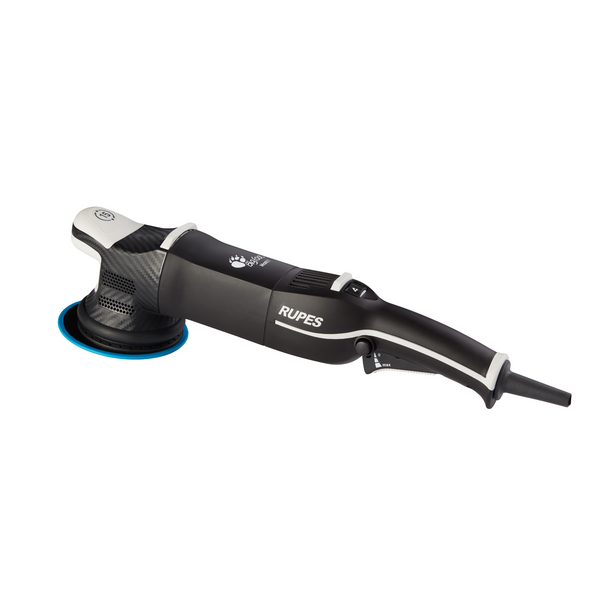
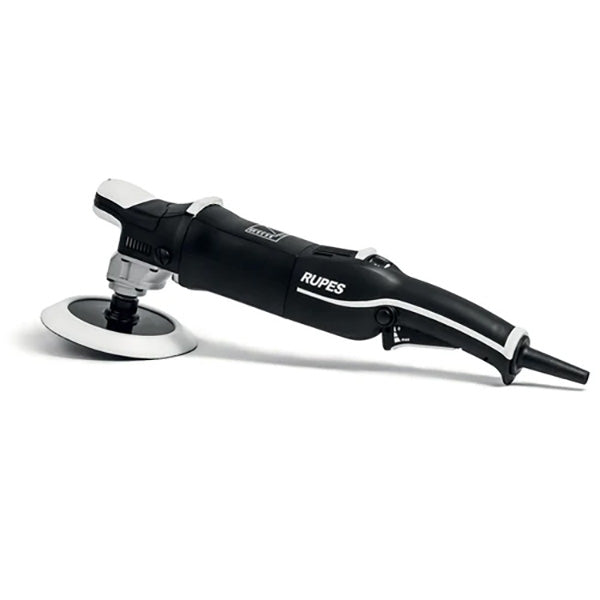
RUPES
LHR15 Mark V
The balanced “do-it-all” DA: control, finish quality, and real-world versatility.
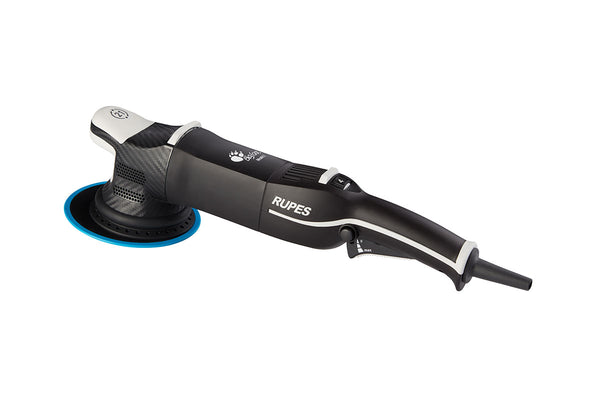
RUPES
LHR21 Mark V
Built for speed on large panels—ideal for volume work and big vehicles.
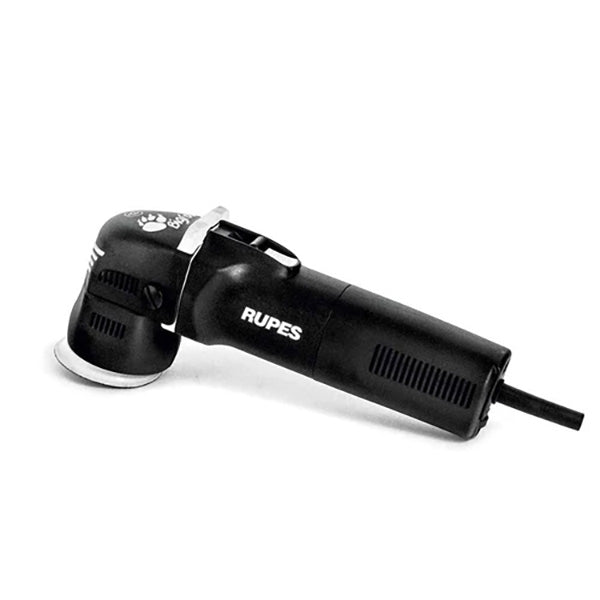
RUPES
LHR75E Mini
Tight curves, bumpers, pillars, headlights—this is how you “finish the job”.
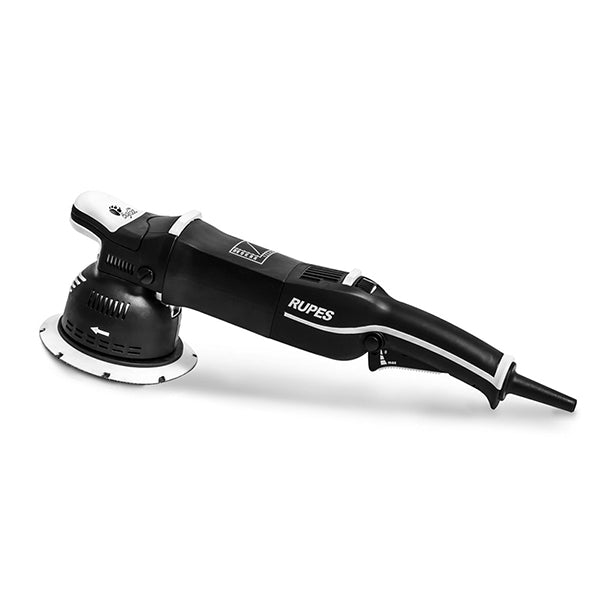
RUPES
LK900E Mille
Gear-driven, forced rotation—more consistent cut when free-spinning DA stalls.
Before you choose: the 3 movements that matter
| Type | How it moves | Risk to clear coat | Learning curve | Who it’s for | Examples at APS |
|---|---|---|---|---|---|
| Dual action (free-spinning DA) | The plate orbits (12, 15 or 21 mm) and spins freely | Low | Easy | Beginners, enthusiasts and most pros | RUPES LHR15 Mark V, LHR21 Mark V, LHR15ES, iBrid HLR15 |
| Gear-driven (forced rotation) | Orbits and is also forced to rotate by gears | Medium | Medium | Heavy correction work that shouldn’t stall on curves | RUPES LK900E Mille |
| Rotary | Spins on its own axis only | High (heat, holograms) | Hard | Pros with technique, heavy correction, wet-sand removal | RUPES LH19E, Mirka POLAROS RP 600X |
1) Free-spinning DA (random orbital)
This is the “default smart choice” for most people:
- Great finishing potential and lower risk of holograms.
- Easier learning curve (especially compared to rotary).
- Perfect for one-steps and safe two-step correction when paired correctly.
2) Gear-driven / forced rotation (a.k.a. “gear-driven DA”)
I see this as the bridge when:
- You want more consistent correction (the plate doesn’t stall, more torque).
- You still want a tool that behaves “safer” than full rotary for many users.
3) Rotary
Rotary is direct power. It can correct fast—no debate. But it also demands technique, heat control, and usually a refinement step to finish perfectly. In experienced hands it’s very effective; in rushed hands it’s how you create holograms and stress your clear coat.
The real dilemma: 15 mm vs 21 mm (why it matters more than you think)
Here’s the clean way to think about it:
- 21 mm: faster coverage on large, flatter panels. If you do volume work, it shows up in your time-per-car.
- 15 mm: easier to control on curves, tighter panels, and complex body lines. For most people, this is the “better daily driver”.
My practical take: If you’re buying one premium DA, the 15 mm is the safest bet. If your shop is constantly doing big vehicles, add (or choose) the 21 mm for speed. Detailed comparison: RUPES LHR15 vs LHR21 Mark V.
Picks by profile: pros and enthusiasts
| If you are… | Recommended type | Models at APS |
|---|---|---|
| A beginner buying a first polisher | 15 mm DA with a 5" plate | RUPES LHR15ES or LHR15 Mark V |
| A serious weekend detailer | 15 mm DA + a 3" mini | LHR15 Mark V + LHR75E Mini |
| A pro doing high volume, SUVs and vans | 21 mm DA + mini | LHR21 Mark V + LHR75E Mini |
| A mobile detailer with no outlet nearby | Cordless DA (iBrid) | RUPES iBrid HLR15 (18 V, 5" plate, 15 mm orbit) |
| Doing heavy correction every day | Gear-driven or rotary (with technique) | LK900E Mille, LH19E, Mirka POLAROS RP 600X |
| Working emblems, trim and tiny areas | Nano / micro | See our best mini polisher guide |
If you’re a beginner and you want to play it safe
Most people should buy a Dual Action (DA) / random orbital polisher.
- If you want a premium “buy once” DA that feels balanced and finishes clean: RUPES LHR15 Mark V.
- If you want a 15 mm RUPES DA at a lower price than the Mark V: RUPES LHR15ES (5" plate, 15 mm orbit, 500 W per RUPES). The Meguiar’s MT300 is currently out of stock at APS; contact us if you’re looking for it.
If you’re a serious weekend detailer (you want a pro finish)
This is the “combo that wins” in real life:
- Main tool: 15 mm DA for balance and finishing quality.
- Second tool: a mini for the areas everyone misses—pillars, bumpers, curves, headlights.
Because the usual story is: doors/hood look amazing… then you see the pillars and bumper curves and realize you didn’t truly finish the car. The mini fixes that.
If you’re a pro or you work high volume
- 21 mm DA for speed on big surfaces.
- Mini for precision and tight work.
- Gear-driven if your workflow is constant, heavy correction and you want consistent torque.
- Rotary as the specialized tool when you have the technique and need max correction speed.
Best Polisher Brands (the Ones You Can Buy at APS)
We only list brands we sell today, with what each one offers according to its manufacturer:
- RUPES (Italy): the widest range in the store: 12, 15 and 21 mm DAs (BigFoot Mark V, LHR15ES, LHR21ES), iBrid cordless versions (HLR15, HLR21, HLR75), nano/micro (iBrid Nano), gear-driven (LK900E Mille) and rotary (LH19E). Shop RUPES
- Mirka (Finland): POLAROS RP 600X, a 6" rotary with a 750 W brushless motor, 700–2,500 rpm and 3.86 lb. Mirka aims it at collision repair, glass and marine work, including clear coat polishing.
- Maxshine: lower-cost detail polishing. The Mini Cordless Polisher V2 is a cordless hybrid rotary + DA nano tool, and the Mini Polishing System MN01 is a mini kit driven by a rotary you already own.
- Meguiar’s: the MT300 Professional DA is out of stock as of this update. We do carry Meguiar’s pads and polishing liquids.
The best brand? For most buyers it’s the one that has the type of machine you need, with pads and parts that are easy to get. That’s why most picks in this guide are RUPES: it’s the brand we stock in every type.
How I compare polishers (a practical framework)
- Safety & learning curve
- Correction efficiency
- Finishing quality
- Control & ergonomics
- Coverage speed (15 vs 21, plus panel shapes)
- System compatibility (pads/liquids that are easy to source and repeat)
Common mistakes that destroy results (and how I avoid them)
- Too much pressure → kills orbit/efficiency and can haze the finish.
- Overloading product → saturated pad = slower cut and unpredictable finish.
- Not cleaning pads → performance drops fast; cut becomes inconsistent.
- Skipping wash/decon → you’re polishing contamination, not paint.
- Chasing perfection on sharp edges → manage risk; clear is thinner on edges.
Keep it simple: Wash + decon, do a small test spot, pick the least aggressive combo that achieves your target, then repeat consistently.
More on this: common mistakes when polishing a car for the first time.
FAQ
What’s the best polisher for most people?
A DA/random orbital. It’s the best balance of safety and results for beginners and enthusiasts—and still a main tool for pros.
DA vs rotary: which is better?
DA is better for most users (finish quality + safety). Rotary is better for heavy correction in experienced hands, but it demands heat control and refinement.
What’s best for headlights and tight areas?
A mini polisher gives you access and control on curves and edges, reducing risk while improving finish quality.
Do I need pads and compound/polish, or just the machine?
You need the system. Pads + liquids make or break the result. Start here: Polishing Pads and Compounds & Polishes.
Orbital or rotary polisher for a car?
Orbital (DA) if you’re starting out or want the lowest risk to your clear coat. Rotary if you already have the technique and need maximum correction, knowing it generates more heat and usually needs a DA refinement step.
Which polisher brand is best?
It depends on the type you need. At APS, RUPES covers every type (DA, mini, nano, gear-driven and rotary), Mirka offers a brushless pro rotary and Maxshine offers lower-cost detail options. See the brands section above.
Final recommendation (simple and direct)
If you force me to boil it down to one line: build your set like this—
- Enthusiast / first serious upgrade: a 15 mm DA + the right pads/liquids, then add a mini for a truly complete finish.
- Pro / high volume: a 21 mm DA + a mini, and consider gear-driven if heavy correction is your daily job.
Already decided you want a DA? See the best dual action polishers by orbit size (12, 15 or 21 mm).
And I’ll end exactly where we started, because it’s the north star for buying: you’re not just buying a machine—you’re buying a result.


